

South Sudan Moves Closer to Regional Power Integration as SUPIP Marks Technical Launch
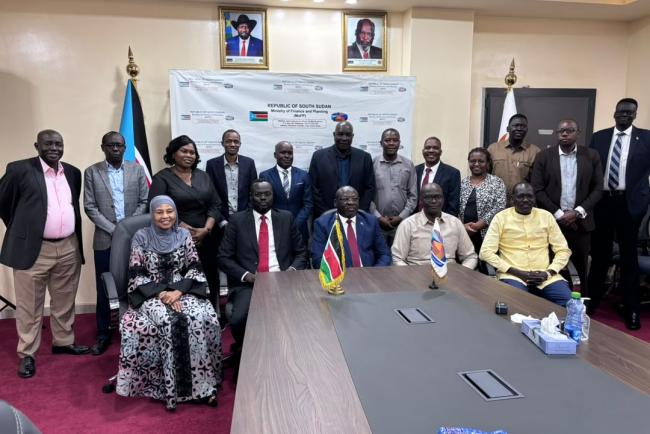
Government and African Development Bank reaffirm commitments to accelerate the flagship interconnection project.
South Sudan's ambition to join the Eastern Africa Power Pool (EAPP) received renewed momentum on 27 October 2026, following the official technical launch of the South Sudan–Uganda Power Interconnection Project (SUPIP), a regional infrastructure investment expected to connect the country's electricity network to the wider Eastern African grid.
The launch, officiated by Hon. Benjamin Ayali Koyongwa the Undersecretary of South Sudan's Ministry of Finance and planning, brought together representatives of the African Development Bank (AfDB), South Sudan Electricity Corporation (SSEC) Managing Director Hon. Eng. Joseph Kor Ajak, Ministry of Energy and Dams Undersecretary Hon. Eng. Madhieu Achuil Mawien, and the Nile Equatorial Lakes Subsidiary Action Program Coordination Unit (NELSAP-CU) Team led by Eng. Jacob Manyoun Deng.
At the centre of the discussions was a shared commitment to accelerate a project that remains a priority for South Sudan's energy development and regional integration.
More Than an Electricity Connection
SUPIP is being coordinated by NELSAP-CU on behalf of South Sudan and Uganda. The project is intended to establish a cross-border electricity transmission link between the two countries, providing South Sudan with a physical connection to the wider EAPP interconnected system.
For South Sudan, this would create opportunities to access electricity traded through the regional network, strengthen its transmission infrastructure and, as domestic generation capacity develops, potentially participate in electricity exports.
The proposed transmission corridor will also accommodate fibre-optic telecommunications infrastructure, extending its potential contribution beyond electricity transmission to improved digital connectivity.
These opportunities make SUPIP an important investment for a country seeking to strengthen its infrastructure and expand its connections with neighbouring economies.
Government and AfDB Commit to Accelerating Progress
During the technical launch, South Sudan's Ministry of Finance reaffirmed the Government's commitment to expediting implementation, recognizing SUPIP as a flagship infrastructure project with the potential to support further infrastructure development in the country.
The Government acknowledged that implementation had fallen behind the original schedule and expressed its expectation that the technical launch would provide renewed impetus to outstanding activities.
The African Development Bank similarly reaffirmed its readiness to advance the project, committing to expedite the internal processes required to support progress.
The Bank also expressed confidence in the teamwork, coordination and preparedness demonstrated by the implementing institutions.
The participation of SSEC, the Ministry of Energy and Dams and NELSAP-CU manifested the importance of continued coordination between the national institutions responsible for implementation, the regional coordinating agency and the financing partner.
Turning Commitments into Implementation
For NELSAP-CU, which coordinates the project on behalf of the two countries, the technical launch provides an opportunity to build on the preparatory and coordination work already undertaken and support progress towards implementation.
The immediate priority is to follow through on the commitments made during the launch, advance the remaining institutional and technical processes, and maintain close coordination among the implementing agencies and the Bank.
While the launch does not mark the completion of the transmission infrastructure, it represents an important institutional milestone for a project whose benefits depend on timely implementation.
Once operational, SUPIP is expected to provide South Sudan with a connection to the regional electricity network, support cross-border power trade and create opportunities for wider infrastructure development.
For South Sudan and Uganda, the next measure of progress will be how quickly the commitments made at the technical launch translate into action on the ground.