
GRIEVANCE REDRESS MECHANISM FOR THE REGIONAL CLIMATE RESILIENCE PROGRAM (RCRP)
GRIEVANCE REDRESS MECHANISM FOR THE REGIONAL CLIMATE RESILIENCE PROGRAM (RCRP)
Regional Climate Resilience Program (RCRP) for Eastern and Southern Africa (P180171)
ENTRO & NELSAP-CU Social and Environmental (S&E) Risks Management
Grievances Redress Mechanism (GRM)
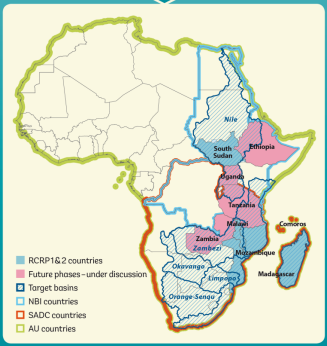 Nile Basin Initiative (NBI) is a partnership of the 10 Nile Basin riparian states with a shared vision objective to promote sustainable socio-economic development through the equitable utilization of and benefit from the shared Nile Basin water resources. The World Bank International Development Association (IDA) has financed the Nile Basin Initiative (NBI) centers through the Eastern Nile Technical Regional Office (ENTRO) and the Nile Equatorial Lakes Subsidiary Action Program Coordination Unit (NELSAP-CU), to implement Phase 1 of the Regional Climate Resilience Program (RCRP) for Eastern and Southern Africa, a program envisioned as a regional multi-phase engagement Series of Projects (SOP). The Program Development Objective (PDO) is to improve the management of water-related climate impacts, with the higher-level aim of strengthening the resilience of populations to climate-related shocks. The target countries are Comoros, Madagascar, Malawi, Mozambique, and South Sudan with the assistance of regional organizations, namely the African Union (AU), Southern Africa Development Community (SADC), and NBI.
Activities being implemented by ENTRO and NELSAP-CU at the regional/basin level include: 1) Development of Flood Risk Mapping for selected areas in the Baro-Akobo-Sobat (BAS) sub-basin (involving Ethiopia and South Sudan); 2) Feasibility study for flood management interventions in the Yabus catchments and associated riverine (involving Ethiopia, South Sudan and Sudan); 3) Integrated Transboundary flood management at the Elegu-Nimule border between South Sudan and Uganda; 4) Enhancing Community Awareness and Preparedness towards climate change adaptation and resilience; and 5) Strengthen capacities of ENTRO, and NELSAP-CU and their member countries.
The deliverables include 1) prefeasibility & feasibility studies; 2) preparation of Environmental and Social Impact Assessments (ESIAs), Resettlement Action Plans (RAPs), detailed engineering designs, and preparation of tender documents for any identified high priority flood management infrastructure/structures in the involved NBI member states; and 3) promotion of the use of early warning system information from the Nile Cooperation for Climate Resilience (NCCR) Flash Flood Early Warning System (FFEW) for the communities in the target flood prone areas.
During the preparation phase of the RCRP document, required environmental and social safeguard instruments were prepared, including environmental and Social Commitment Plan (ESCP), the Stakeholder Engagement Plan (SEP), Labor Management Procedures (LMP), and it was also agreed that the Grievance and Redress Mechanism (GRM) prepared for the then NCCR Project can be adapted to RCRP.
Contact Grievance Focal Points of the project implementation Sites (BAS, YABUS and Unyama):
- BAS Project Implementation Site
Gambela, Ethiopia
Mr. Domach Bol Wur
By email: domachwur@yahoo.com
By Phone: +251917549077 BAS Project implementation site
Upper Nile State, Melakal
Mr. Butros Awuol Maker Ajak
By email: bawuolM84@gmail.com
By phone: +211 910 552288
- YABUS Project Implementation Site
Asosa, Ethiopia
Mr. Yusuf Mubarek Nuredin
By email: nuryosuf456@gmail.com
By Phone: +251 910 316940 - YABUS Project Implementation site
Upper Nile State, Republic of South Sudan
Afudi Hamoda Afudi
Email: afoudihamodi449@gmail.com
Phone: +211 923 942363 / 910152023
Unyama Project Implementation Site
Upper Nile Water Management Zone, Uganda
Ms. Mirembe Rachael
By email: rachaelmirem@gmail.comPhone: +256786416448
Unyama Project Implementation Site
Eastern Equatorial State, Torit
Nyika Charles Jacob
Email: nyiika.78@gmail.com
Phone Number: +211921 430 363
ENTRO Grievance Focal Point:
Assefa Gudina Muleta (PhD)
By Email: agudina@nilebasin.org
By Phone: +251911056845
Contact the World Bank Grievance Redress Service
Complaints must be in writing and addressed to the GRS. They can be sent by the following methods:
Online, access the online form at (https://www.worldbank.org/en/projects-operations/products-and-services/grievance-redress-service#file)
By e-mail to: grievances@worldbank.org
By letter or by hand delivery to the World Bank Headquarters in Washington D.C., United States, or any World Bank Country Office;
A suggested form for submitting the complaint is available at: